
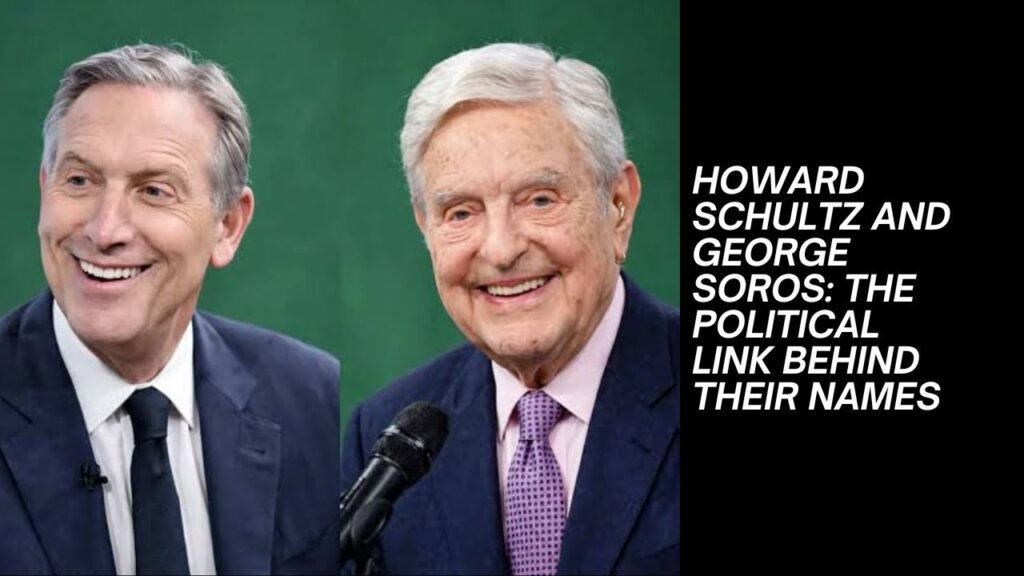

Howard Schultz and George Soros are connected through American Bridge 21st Century, a political committee that received donations from Soros and later filed a complaint against Schultz in 2019. The complaint questioned whether Schultz should have registered as a presidential candidate and reported his campaign-related spending.
However, available public records do not establish that Schultz and Soros are personal friends, relatives or business partners. Their connection is based on their links to the same political organisation, rather than a confirmed direct relationship.
It is also important to understand that donating money to an organisation does not automatically mean a donor controls its decisions. Official records identify American Bridge and Bradley Beychok as the parties behind the complaint against Schultz, not Soros. The Federal Election Commission (FEC) eventually dismissed the case.
Howard Schultz and George Soros: A Look at Their Backgrounds
Howard Schultz: The Businessman Behind Starbucks
Howard Schultz is widely recognised for helping turn Starbucks into a global coffeehouse brand. According to the company’s history, he joined Starbucks in 1982 as its director of retail operations and marketing. During a visit to Italy in 1983, he became interested in the country’s espresso-bar culture and saw an opportunity to introduce a similar experience in Seattle.
Schultz later launched Il Giornale, a coffee business that acquired Starbucks’ assets in 1987 with support from local investors. The company then adopted the Starbucks name. However, Starbucks had originally opened its first store in 1971, before Schultz joined the business. His main contribution was helping develop and expand the company into the brand known today.
Schultz served as Starbucks’ chief executive during several periods of its growth. After his final term as interim CEO, he left the company’s board in September 2023 and became chairman emeritus.
George Soros: From Investment Success to Global Philanthropy
George Soros made his fortune through financial investments. His official biography from the Open Society Foundations states that he was born in Hungary in 1930 and studied at the London School of Economics. He moved to the United States in 1956 and established his own hedge fund in 1970.
Soros began his philanthropic activities in 1979 by providing scholarships to Black South Africans living under apartheid. Over time, he developed a wider network of charitable organisations that became the Open Society Foundations. Its stated goals include supporting human rights, equality and justice around the world.
Although Soros is known for both investing and philanthropy, his connection to Schultz in this article relates specifically to his financial support for an American political committee.
The Organisation That Links Schultz and Soros
American Bridge 21st Century is a Democratic-aligned political committee that gathers information about political opponents for use in campaigns and public discussions. The Center for Public Integrity identified Soros as one of the committee’s major donors in its reporting on fundraising in 2016.
Federal Election Commission records also support this connection. A financial report submitted by American Bridge in 2017 lists a contribution from Soros, showing that his financial support came before the dispute involving Schultz.
The connection to Schultz developed in 2019, when he was considering an independent run for the US presidency. American Bridge subsequently filed a complaint questioning whether his political activities required him to register as a candidate and report his campaign finances.
These events establish an indirect political connection between the two men. Soros supported an organisation that later challenged Schultz’s activities. However, the available records do not show that Soros personally directed the complaint or worked with Schultz on a shared political or business project.
Why Howard Schultz’s Presidential Plans Attracted Attention
On January 27, 2019, Schultz appeared on CBS’s 60 Minutes and announced that he was seriously considering an independent campaign for the US presidency in 2020. His proposed campaign would have been separate from the Democratic and Republican nomination processes.
The possibility raised concerns among some Democrats. They feared that Schultz could attract voters who might otherwise support the Democratic nominee, potentially helping Donald Trump win re-election. These concerns reflected political predictions at the time, rather than proof of what would have happened in the election.
Schultz eventually announced on September 6, 2019, that he would not run for president. ABC News reported that his decision involved concerns about how an independent campaign might affect the election, particularly if Democrats selected a moderate candidate. Health problems had also interrupted his plans.
As a result, Schultz’s presidential effort remained an exploration of a possible campaign rather than a completed independent bid for the White House.
Inside the Complaint Against Schultz and Its Outcome
Questions About Campaign Finance Rules
The complaint against Schultz was filed on February 7, 2019, and was recorded by the FEC as Matter Under Review 7567. It alleged that Schultz had moved beyond simply considering a presidential run and should have registered as a candidate and disclosed relevant financial information.
According to the FEC general counsel’s report, the activities in question included hiring political advisers, carrying out opinion polls and preparing for paid advertising. These details formed part of the allegations and were not, by themselves, findings that Schultz had broken the law.
The central question was whether Schultz’s actions still counted as exploring a possible campaign or whether he had officially become a candidate. US campaign finance rules allow potential candidates to test public support through activities such as polling, phone calls and travel. Whether these activities cross the legal threshold depends on the circumstances.
Therefore, spending money while considering a presidential run does not automatically prove that someone has violated campaign finance rules.
The Federal Election Commission Closed the Case
The FEC’s records show that the case ended on November 9, 2021. Commissioners held two votes on proposed motions, and both resulted in a 3–3 tie. The commission then voted unanimously, 6–0, to dismiss the allegation and close the case.
Although all six commissioners agreed to dismiss the complaint, they did not unanimously support the same proposed reasoning during the earlier votes. A separate statement from three commissioners explained their view that the available evidence did not show that Schultz’s expenses had gone beyond permitted exploratory activities.
This outcome is an important part of the story. Reporting only the complaint without mentioning its dismissal would leave out the final regulatory decision.
What the Evidence Actually Shows About Their Relationship
The available records support three main points. George Soros donated to American Bridge 21st Century, the committee filed a complaint against Howard Schultz, and the Federal Election Commission later dismissed that complaint.
Claims that Soros personally organised the action against Schultz or that the two men were involved in a direct political dispute would require further evidence. This could include verified communications, official documents or reliable testimony showing that Soros was personally involved in the decision.
Similarly, describing the two men as business partners would require evidence of a shared business venture or formal commercial arrangement. The sources reviewed for this article do not establish such a relationship. This does not prove that the men have never met; it simply means that a personal connection has not been demonstrated by the available evidence.
The Real Story Behind Howard Schultz and George Soros
The connection between Howard Schultz and George Soros is best understood through American Bridge 21st Century and the political events surrounding Schultz’s possible presidential campaign in 2019.
Soros financially supported the committee, which later challenged Schultz’s campaign-related activities. The Federal Election Commission ultimately dismissed the complaint in 2021.
There is no established evidence in the sources reviewed here that the two men were personal friends, family members or business partners. Keeping the donation, the committee’s complaint and the final decision separate helps explain what happened without making unsupported claims about their relationship.
The key takeaway is that their documented connection is indirect and political. Understanding the difference between an organisation’s donors, its actions and the decisions of regulators provides a clearer and more accurate picture of the events.