
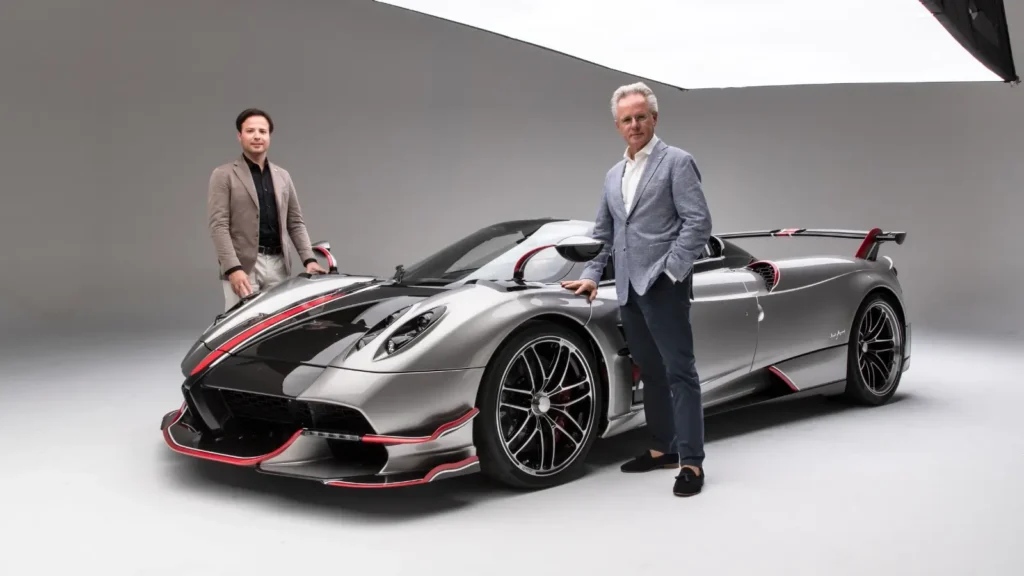

Horacio Pagani is one of the most famous names in the world of supercars. He is admired for both his engineering skills and the way he turned fast cars into works of art on wheels. He is the founder of Pagani Automobili and has made some of the most exclusive and beautiful hypercars in history, such as the Zonda and Huayra. His trip from making models in the middle of nowhere Argentina to running a small supercar company in Italy is just as interesting as the cars he makes.
Early Life and Background
He was born in the Argentinean town of Casilda on November 10, 1955. Casilda is in the Santa Fe Province. Horacio grew up in a simple home with Italian immigrant parents. He was interested in art, design, and engineering from a young age. He was always interested in tools and how they worked, even when he was young. He loved experimenting with mechanical parts and building models, which quickly turned into a constant quest for perfection. Leonardo da Vinci had a lot of influence on Pagani. His idea of combining art and science became a guiding concept for his work.
Net Worth and Business Glory
There are new figures that say Horacio Pagani’s net worth is between $100 million and $150 million USD. His main source of wealth is his personally owned company, Pagani Automobili, which makes a few custom hypercars every year and often sells for more than $2 to $5 million. Pagani makes cars, but he also owns Modena Design, a company that makes parts out of advanced composite materials and sells them to top auto and aircraft companies. Even though he is very successful, Pagani is still very active in the creative and technical side of his business. He values craftsmanship and exclusivity over mass production.
Education and the Start of a Career
Pagani didn’t have a lot of opportunities to get formal engineering schooling in Argentina. He learned most of mechanics, physics, and materials science on his own. He went to a nearby technical institute to study industrial design and engineering, but he learned a lot by doing things himself. His first projects were go-karts, furniture, and small machines when he was in his teens. Many people were amazed by how early on he used fiberglass and other lightweight materials. This earned him a reputation in the racing community for being creative and good at solving problems.
A Job in Argentina
In the beginning of his career in Argentina, Pagani started a small workshop where he made race car parts and tried out different ways to design cars. He quickly learned that even though he was smart and had great ideas, Argentina did not have the advanced materials or industrial infrastructure to make his plans come true. His dream was to work in the center of automotive innovation, so he set his sights on Modena, Italy, home of famous car names like Ferrari, Maserati, and Lamborghini.
Getting the Dream: Moving to Italy
Some tools and a dream were all Pagani brought with him when he moved to Italy in the late 1970s. The move was risky and unclear, but he didn’t give up and it paid off. He finally got hired by Lamborghini after months of knocking on doors and looking for work. Even though he started out with simple chores, senior engineers quickly noticed how smart and driven he was. He quickly rose to prominence and played a big role in several of Lamborghini’s most important projects.
Having fun at Lamborghini
Pagani worked at Lamborghini on a number of groundbreaking projects, such as the Countach Evoluzione, the LM002 (a high-end off-road car), and the P140 prototype. One of the most important things he did was push for the use of carbon fiber in car design at a time when the material was still seen as experimental. When Lamborghini refused to buy an autoclave, which is an oven used to cure carbon fiber, Pagani made the choice to make his own. This moment changed everything for him, and it led him to leave everything behind and start his own business, where he could fully follow his vision.
Starting up Pagani Automobili
Horacio Pagani started Modena Design in 1991. It is a business that makes carbon fiber parts. Its success helped him get the money and skills he needed to start Pagani Automobili S.p.A., which he did in 1992. His goal was very high: to make a hypercar that used the best materials, engineering, and artistic skills. Pagani’s unique style combined aerodynamic speed with hand-sculpted design, making cars that were both powerful machines and useful works of art.
The Time of Zonda
The Zonda C12, which was shown for the first time at the 1999 Geneva Motor Show, was Pagani’s first creation. The Zonda became a big hit right away. It had a Mercedes-Benz AMG V12 engine and was mostly made of carbon fiber. Its future looks, careful attention to detail, and thrilling performance were praised by critics. As time went on, the Zonda changed with limited-edition types like the Zonda F, Zonda Cinque, Zonda R, and the very rare HP Barchetta. Each version pushed the limits of what was possible in terms of art and exclusivity in cars. Often, they sold for millions of dollars and had long waiting lines.
The Huayra and Other Things
Pagani made the Huayra, a hypercar named after the Incan god of wind, in 2011. The Huayra built on the success of the Zonda. It had active aerodynamics, a twin-turbocharged AMG V12 engine, and cutting-edge carbon-titanium engineering. The Huayra made Pagani even more famous as a star in making custom cars, where each car is made to fit the needs of its owner. Later versions, like the Huayra BC, Huayra Roadster, and Huayra Codalunga, showed that Pagani was always looking for new ways to improve design, performance, and customer satisfaction.
Design Thoughts
An important part of Horacio Pagani’s work is his deep respect for Leonardo da Vinci’s ideas: “Art and science are disciplines that must walk together.” Pagani thinks of every car as a perfect mix of form and function. There is no detail that is too small, from the finely made leather insides to the shiny titanium bolts. His designs show that he wants to make people feel something, not just speed. Every Pagani is more than just a car; it’s a work of art that shows off its beauty, speed, and uniqueness.
Life and values of an individual
Pagani is famous, but he is known for being humble and living a quiet life. He is still very involved in every step of making the car, and you can often see him in the workshop going over details or drawing up new ideas. The family’s mission and values will live on into the future thanks to Christopher Pagani, his son, who has become a leader in the company. The way Horacio lives his life and the business he has created are both shaped by his commitment to authenticity and perfection.
Legacy and Effects on the Industry
Horacio Pagani has made a big impact on the world of cars. His work has had an impact on how hypercars are made today, especially the use of composite materials and very specialized production methods. Even more important, he has raised the car to the level of fine art. The Pagani Automobili brand is more than just a car company. It’s a sign of what can be done when engineering meets desire, creativity, and vision.
Giving and receiving awards
Pagani’s work has been praised around the world with design awards, engineering honors, and television appearances. Many TV shows, like Top Gear, Jay Leno’s Garage, and Carfection, have shown him and his cars and said they are wonders. People who love cars, artists, and designers all go to his classes on a regular basis to see the careful work that goes into making each piece.
In conclusion
The story of Horacio Pagani is an amazing example of what can happen when hard work, creativity, and ability come together. Pagani’s trip from a small town in Argentina to the top of the luxury car business shows that following a dream, no matter how far away it seems, can lead to amazing things. His cars aren’t just fast or good at what they do; they also change the idea of what a soulful car is. With an eye on the future, Pagani Automobili is making beautiful cars, and everyone is looking forward to the next achievement from this modern-day Da Vinci artist. Every curve, finish, and design shows real passion for cars, whether it’s in the artistry of Pagani’s creations or the skill shown in detailing in Calgary.