
Key Takeaways
- Hard water contains elevated levels of dissolved calcium and magnesium.
- It can leave scale on fixtures, reduce soap performance, and, over time, affect water-using appliances.
- Traditional water softeners remove hardness minerals, while many salt-free products are conditioners that help manage scale.
- The right system depends on water test results, household size, flow needs, and local installation requirements.
- Demand-initiated regeneration can reduce unnecessary salt and water use.
- Simple routine maintenance helps prevent salt bridges, leaks, and a return of hard-water symptoms.
Hard water is a common household issue, especially in areas supplied by mineral-rich groundwater. It is not usually something homeowners notice all at once. Instead, the clues tend to build slowly: chalky deposits around faucets, cloudy glasses from the dishwasher, stiff towels, soap that seems difficult to rinse away, or appliances that do not perform as efficiently as they once did. When those signs become persistent, consulting water softener installation experts in Vernal, Utah can help homeowners match a treatment option to the home’s actual water conditions.
A good solution starts with testing rather than guessing. Water chemistry, household water use, plumbing layout, and local drainage rules all matter. A properly sized softener can make cleaning easier and reduce mineral buildup, but it is not a universal answer to every water-quality concern. Understanding the distinction between softening, conditioning, and filtration makes it easier to invest wisely.
Why Hard Water Creates Household Problems
Hardness refers primarily to the dissolved calcium and magnesium in water. As water moves through soil and rock, it can pick up naturally occurring minerals before reaching a well or public water system. The U.S. Geological Survey’s guide to water hardness explains that these minerals can react with soap, leave residue on glassware, and form scale when water is heated.
In daily life, hard water can mean more detergent is needed to create a good lather. It may leave white or tan deposits on showerheads, faucets, coffee makers, and humidifiers. Over time, scale can narrow water passages within fixtures, reducing flow. Water heaters are especially vulnerable because heat encourages minerals to settle out and accumulate on heating surfaces.
How To Tell If A Home Has Hard Water
The most reliable first step is to review a current municipal water-quality report or arrange a water test. Public systems typically publish reports, but conditions at an individual home may still vary. Private well owners should use a certified laboratory or qualified water professional, particularly if the water’s appearance, odor, or taste has changed.
- Check hardness results in grains per gallon or milligrams per liter.
- Use a home test strip only as a rough screening tool, not as a complete diagnosis.
- Ask about iron, manganese, sediment, sulfur odors, and pH, especially for well water.
- Test treated water if spotting or scale returns after a softener is installed.
Visible scale does not reveal every possible issue. A softener is designed for hardness minerals, not for bacteria, lead, nitrates, PFAS, or every chemical contaminant. If testing identifies another concern, separate treatment may be needed.

Water Softener Vs. Water Conditioner
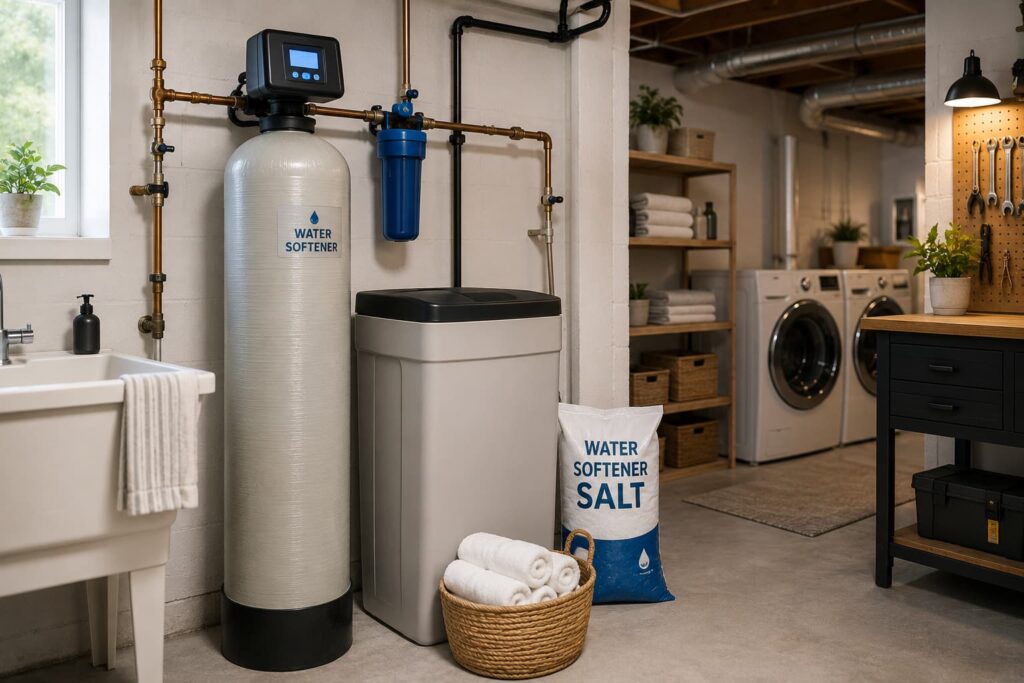
These terms are often used interchangeably in advertising, but they describe different approaches. A conventional ion-exchange water softener removes calcium and magnesium from the water and replaces them with sodium or potassium ions. This is true softening, and it reduces the minerals that create soap scum and scale.
- Water softener: Uses ion exchange to reduce hardness minerals.
- Water conditioner: May alter how minerals form scale, but generally does not remove them.
- Whole-home filter: Can target sediment, chlorine, taste and odor, or specific contaminants, depending on the media used.
- Reverse osmosis system: Usually treats drinking water at a single faucet rather than the entire home.
Salt-free conditioners can be a reasonable choice where brine discharge is restricted or where the goal is limited scale control. However, homeowners should not expect the same laundry, soap, or spot-reduction results produced by a correctly operating ion-exchange softener.
How To Choose The Right System Size
Bigger is not automatically better. An oversized unit can cost more than necessary, while an undersized unit may regenerate too often and struggle during busy periods. Proper sizing considers hardness, occupants, expected daily water use, peak flow demand, and the presence of iron or manganese.
- Measure the hardness level with a dependable water test.
- Count regular occupants and consider high-use routines, such as multiple showers or frequent laundry.
- Estimate daily water use and identify peak-demand times.
- Account for iron or manganese, which can affect resin performance.
- Compare usable grain capacity, regeneration efficiency, and service flow rate.
- Confirm adequate space for the tanks, drain line, electrical connection, and service access.
Salt-Based And Salt-Free Options
Salt-based softeners usually deliver the clearest results for truly hard water, but they require salt, power, a drain connection, and periodic regeneration. Salt-free systems often require less routine attention and do not create brine, but they are best viewed as scale-management devices. The better choice depends on test results, maintenance preferences, available space, and local requirements.
Water And Salt Efficiency In 2026
Efficiency matters because regeneration uses both water and salt. The EPA’s guidance on cation-exchange water softeners recommends comparing efficiency and choosing settings that match real household needs, rather than relying solely on the upfront price.
- Choose demand-initiated regeneration when practical.
- Program the system using the tested hardness level, not an estimate.
- Avoid unnecessary timer-based regeneration if household water use changes often.
- Use the manufacturer-recommended salt and avoid overfilling the brine tank.
- Consider bypassing softened water for outdoor irrigation when appropriate.
- Verify local rules before connecting a brine discharge line.
A Simple Water Softener Maintenance Routine
Monthly Checks
- Check the salt level and break up any crusted layer near the top.
- Look for a salt bridge, which is a hardened layer that prevents salt from reaching the water below.
- Inspect for leaks, standing water, unusual sounds, or error messages.
- Make sure the control panel shows normal operation.
Seasonal And Annual Checks
Review the hardness setting after changes in water quality or household occupancy. Inspect bypass valves and drain lines for kinks or damage. When needed, clean the brine tank, inspect serviceable seals and screens, and have the control valve checked. If mineral spotting returns, test the water before assuming the resin tank needs replacement.
Common Signs Of A Failing System
Warning signs include hard-water symptoms returning, unusually fast salt use, constant draining, low pressure, an overflowing brine tank, or a unit that never regenerates. Before replacing major components, check whether the system is plugged in, confirm the bypass is in the service position, inspect for a salt bridge, verify settings, and examine the drain line for restrictions.
Hard Water Myths Worth Clearing Up
- Myth: Hard water is automatically unsafe to drink. Fact: Hardness is generally a maintenance and aesthetic issue, not the same as contamination.
- Myth: Every filter removes hardness. Fact: Many filters improve taste or remove particles without reducing calcium or magnesium levels.
- Myth: A larger softener is always better. Fact: Poor sizing can increase expense, waste, and maintenance needs.
- Myth: Salt-free systems remove hardness minerals. Fact: Most condition mineral behavior rather than remove minerals from the water.
Questions To Ask Before Buying Or Replacing A System
- What is the tested hardness level, and are iron or manganese present?
- How much water and salt does the system use per regeneration cycle?
- Does it regenerate by demand or on a fixed timer?
- What yearly maintenance and replacement parts should be expected?
- How does the system operate during a power outage?
- Is the drain connection compatible with local plumbing rules?
- Which components and labor are covered by the warranty?
Conclusion
Hard-water treatment works best when it is based on measured conditions and realistic household needs. A well-sized, efficient, and well-maintained system can reduce scale buildup, improve cleaning results, and help protect plumbing fixtures and appliances. Start with a water test, compare treatment types honestly, and keep up with regular checks to get the most dependable long-term results.