
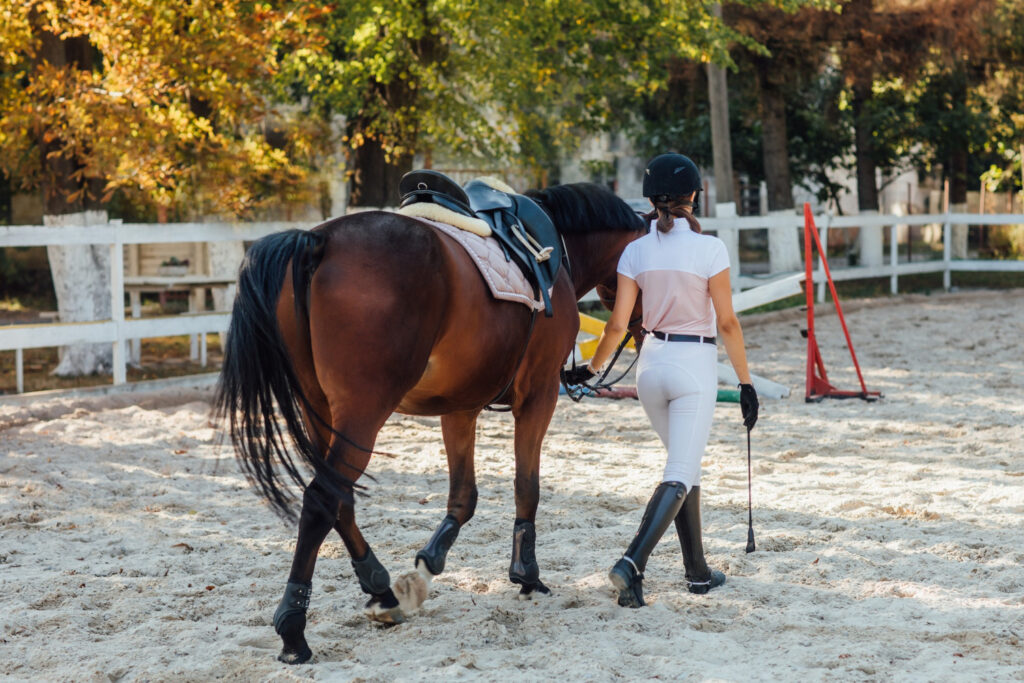

Typically, the kind of sand that is used is masonry sand, manufactured sand, or slag sand. Masonry sand is as it sounds, “washed and screened.” It’s a fine material that allows for a true cushion floor, which is ideal for indoor arenas. The manufactured sands give more cushioning and produce less dust, perfect for both indoor and outdoor arenas. Lastly, slag sand is the best all-around sand for equestrian use. It’s commonly referred to as “spent grit” and is a waste product of the manufacturing process that hasn’t caused any environmental damage. It’s a super hard, coarse sand that provides a very cushioned surface with a lot of grip. It’s also way heavier than regular sand and doesn’t freeze in the winter, making it perfect for both indoor and outdoor.
Matching the Sand Specification to the Discipline
Dressage, jumping, and reining have different requirements for footing. Dressage needs cushion and rebound for the slow work and the sustained lateral movement. Geotextile additives, which are synthetic fibers we mix in with the sand to retain moisture, can give you the rebound without sacrificing the stability your horse needs to work safely in that lateral movement.
Jumping and reining need high shear strength. When your horse leaves the ground or slides to a stop, footing can’t give. The high shear strength keeps it from shifting under that lateral force. The grain gradation, or the distribution of particle sizes in the footing mix you get from us, controls a lot of that as well. A well-graded mix with particles across sizes will pack together better than a single-sized mix.
When it comes to getting the right horse arena footing, you need a supplier that understands gradation and mineral consistency, not someone who sells things to concrete contractors and calls it good for arenas too.
Grain Shape is the Variable Most Buyers Miss
Before you worry about mineral type or particle size, grain shape is the one factor that has the most impact on how a surface behaves under loading. Sand breaks down into three core shapes, defined by their edges: round, sub-angular, and angular. Round grains function like ball bearings. They don’t lock together, which means the surface shifts and rolls under a horse’s foot rather than holding it. This lateral movement is what contributes to instability and the associated tendon and ligament trauma.
Sharp, angular grains, by contrast, cohere too much. They lock together so efficiently that there is no give, and the surface becomes unyielding and refuse-like. Ideally, you want grains with “blunted” edges that lock together but still give. This is most easily represented by grains with sub-angular edges, which have enough irregular surface area to interlock and resist lateral movement. At the same time, the edge is sufficiently blunted that the material will still compress slightly when a horse loads it. This provides the cushion and concussion reduction you’re looking for.
Mineral Purity and Why Silica Matters
Not all sand consists of the same minerals. For instance, “bank run” sand, which comes straight from a river bed or pit, contains a mixture of quartz, feldspar, limestone, and clay particles. Those softer minerals break down quickly, as we noted above and the clay component acts as a binder, similar to silt but stickier. When clay erodes from the softer minerals, that can also cause dust that sticks to hooves and other aggravating factors. But, when clay erodes from the softer minerals, it loses its ability to bind and becomes dust.
Silica sand, being quartz, is more durable. Both SiO2 (silica) and clay cause the intentionally loosened portion of your riding surface to pack down and become too hard when overwatered, like Cape Cod roads after a rainstorm. Resilient footing should include, by industry standards, 90% or more of silica (SiO2). That helps keep it loose, dust-free and binding to the hoof.
Ask the supplier for a mineralogy report. They should have one. If not, buy at your own risk. The supplier is likely selling “pretty good for general purposes” material. True, high-quality performance surfaces are carefully engineered and manufactured to perform.
The Sieve Analysis – What it Tells You Before You Buy
A sieve analysis is a basic test during which a sample of aggregate (in this case, sand) is washed through a series of mesh sieves that divide the sample into several size fractions and shows you the percentage of total material by weight that is finer than any given size (that’s the technical explanation). It costs next to nothing, but it’s as revealing a test as you can get for any sort of particulate material.
For equestrian applications, you’re aiming to avoid a high percentage of fines (2mm). A fines-rich product compacts like concrete and doesn’t drain, yet holds water like a saturated sponge. A particle size distribution with too high a percentage of coarser particles doesn’t bind at all, drains and dries excessively fast and can be like riding on concrete ball-bearings.
Just ask your potential supplier for a copy of their most recent sieve analysis. They won’t have one? That probably tells you all you need to know.
Moisture Management and Long-Term Maintenance
The type of sand you use for your arena impacts how often you need to water it. For instance, sand that has a high silica content and is sub-angular doesn’t hold moisture. This kind of sand is great for drainage and keeping the surface firm but requires more frequent watering in dry conditions. If geotextile fibers or rubber crumb are used in the sand, they increase moisture retention and reduce water frequency without causing the sand to become too soft.