
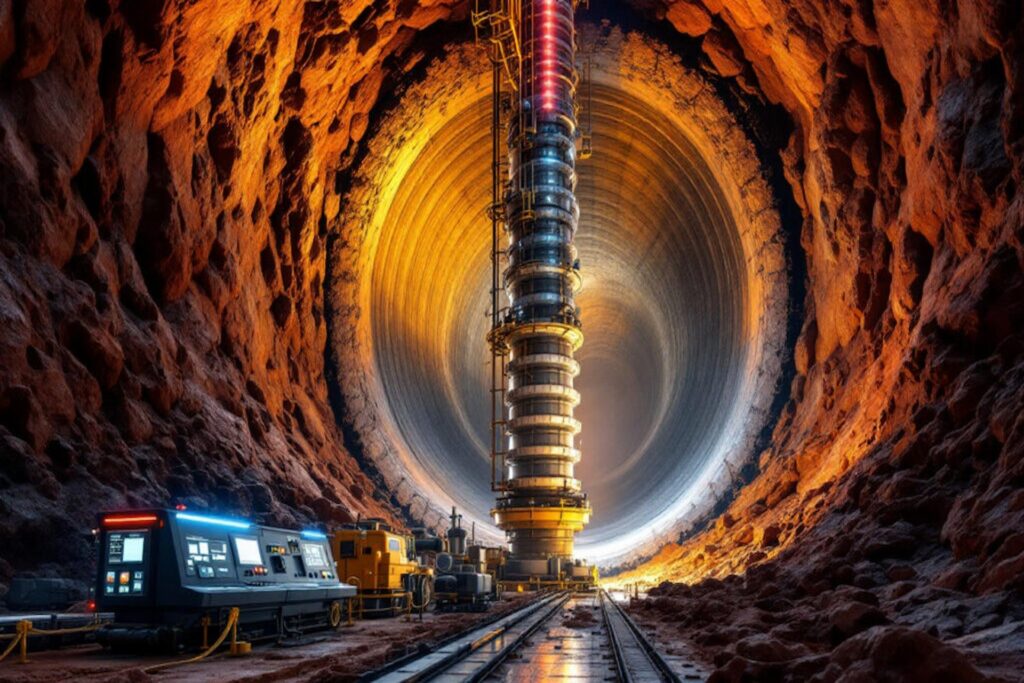

Raise boring is one of the most important methods used in modern underground excavation. It allows mining and civil engineering teams to create vertical or inclined openings with greater control, safety, and accuracy than many traditional drilling and blasting methods. From ventilation shafts to ore passes and service tunnels, raise borers play a key role in connecting underground levels and improving access within complex sights.
In mining, raise boring often works alongside wider material handling and processing systems, including crushers, conveyors, loaders, and vibrating mining screens used to separate and process excavated rock. While these systems operate at different stages of the project, they all support the same goal: moving, managing, and preparing rock safely and efficiently.
What Is a Rail Borer?
A raise borer is a large drilling machine used to create a circular shaft between two underground levels or between the surface and an underground opening. The process begins with a small pilot hole drilled from one level to another. Once the pilot hole reaches the target point, a wider cutting head, known as a reamer, is attached. The machine then pulls the reamer back through the rock, enlarging the hole to the required diameter.
This method is known as “raise boring” because the final opening is typically created upward from a lower level towards the machine. However, the pilot drilling stage usually starts from the top. The result is a smooth, stable shaft that can be used for ventilation, access, ore movement, utilities, or emergency escape routes.
How Raise Boring Works
The raise boring process follows a clear sequence. First, engineers survey the site and plan the shaft alignment. Accuracy is essential because the pilot hole must reach the correct breakthrough point. Even a small deviation can affect the final position of the shaft.
Next, the raise boring machine is installed on a prepared foundation. The machine drills a pilot hole using a rotating drill string. This hole is usually much smaller than the final shaft, but it sets the path for the entire excavation.
Once the pilot hole reaches the lower level, workers attach the reaming head to the drill string. The raise borer then pulls the reamer upwards while rotating it. Cuttings fall to the lower level, where they are removed using loaders, conveyors, or other handling equipment.
The process continues until the reamer reaches the upper level. At that point, the shaft is complete and can be inspected, supported if necessary, and prepared for its final use.
Main Uses of Raise Borers in Mining
Raise borers are widely used in underground mining because they provide a controlled way to create essential openings. One of their most common uses is ventilation. Mines need reliable airflow to remove heat, dust, fumes, and gases from working areas. Raise-bored shafts help move fresh air into the mine and extract contaminated air safely.
They are also used to create ore passes. These are vertical or inclined openings through which mined material can move from one level to another by gravity. A well-designed ore pass can reduce haulage distances and improve the flow of material through the mine.
Raise borers are also used for the following:
- Service shafts for cables, pipes, and utilities
- Escape ways for emergency access
- Slot raises in stoping operations
- Drainage holes and water management openings
- Access connections between underground levels
Because the shafts are usually smooth and consistent, they often require less finishing work than openings created by blasting.
Use in Tunnel and Civil Engineering Projects
Raise boring is not limited to mining. It is also used in civil engineering, tunnelling, hydropower, and infrastructure projects. In tunnel development, raise borers can create ventilation shafts, pressure shafts, drainage shafts, and access openings.
For example, a long transport tunnel may need vertical shafts to support airflow during construction and operation. A hydropower project may use raise boring to create steep shafts that carry water between different elevations. In urban infrastructure, the method may be used where controlled excavation is required and vibration from blasting needs to be reduced.
The technique is especially useful where accuracy, safety, and minimal disturbance are important. Since raise boring does not rely on repeated blasting, it can reduce shock to surrounding rock and nearby structures.
Why Raise Boring Is Preferred
One of the main advantages of raise boring is safety. Traditional shaft sinking and manual raise excavation can expose workers to unstable ground, falling rock, fumes, and confined working conditions. Raise boring reduces the need for people to work inside the developing shaft during excavation.
Another key benefit is precision. The pilot hole provides a defined path, and modern machines can achieve accurate results over considerable distances. This makes raise boring suitable for projects where alignment matters, such as ventilation networks, ore handling systems, and tunnel connections.
Raise boring can also produce a smoother shaft wall. This helps airflow in ventilation shafts, reduces friction in ore passes, and may lower the amount of ground support required, depending on rock conditions.
Key Advantages of Raise Boring
Raise boring is valued because it offers a strong balance of safety, speed, and quality. Its benefits often include:
- Reduced exposure of workers to unsupported ground
- Lower vibration compared with drill-and-blast methods
- Accurate shaft alignment
- Smooth and consistent shaft profiles
- Efficient removal of cuttings from the lower level
- Less overbreak in suitable ground conditions
- Suitability for vertical and inclined openings
These advantages make it particularly useful in deep mines and complex underground developments where reliability is essential.
Limitations and Site Considerations
Although raising boring is highly effective, it is not suitable for every project. The method requires access to both the upper and lower levels, as the reaming head must be attached from below. This can limit its use in areas where the lower breakthrough point has not yet been developed.
Ground conditions also matter. Raise boring works best in competent rock that can support the opening as it is excavated. Highly fractured, weak, or unstable ground may require additional investigation, support planning, or alternative excavation methods.
Machine size, shaft diameter, depth, inclination, and site logistics also influence whether raise boring is practical. The equipment is large and requires a stable setup area. Engineers must also plan how cuttings will be removed from the lower level to avoid delays.
Raise Boring and Project Efficiency
In many underground projects, raise boring improves efficiency by reducing manual work and creating shafts more predictably. Because the method is mechanical and carefully controlled, teams can plan production schedules with greater confidence.
It also supports better integration between excavation, haulage, ventilation, and processing. In a mining operation, for example, raise-bored ore passes can help move material to crushing and screening areas more efficiently. Ventilation raises can improve working conditions, allowing crews and equipment to operate safely across multiple levels.
The long-term value of a raise-bored shaft often extends beyond construction. A well-positioned ventilation or ore pass system can support mine productivity for many years.
The Role of Technology in Modern Raise Boring
Modern raise borers are more advanced than earlier machines. Many now include improved control systems, better drilling accuracy, stronger reaming heads, and monitoring tools that help operators track machine performance.
Digital planning and surveying also play an important role. Engineers can model shaft routes, assess geological risks, and plan support requirements before drilling begins. This reduces uncertainty and helps teams make better decisions during construction.
As underground projects become deeper and more technically demanding, raise boring technology is likely to remain an important part of safe and efficient development.
Conclusion
Raise borers are specialised machines used to create vertical and inclined shafts in mining, tunneling, and civil engineering projects. By drilling a pilot hole and then enlarging it with a reaming head, they produce accurate, smooth, and reliable openings between underground levels or from the surface to depth.
Their main value lies in safety, precision, and efficiency. They reduce the need for workers to excavate inside unsupported shafts, limit vibration, and create high-quality openings for ventilation, ore movement, services, drainage, and access. While they require suitable ground conditions and careful planning, raise borers remain one of the most effective tools for modern shaft and tunnel development.