


Key Takeaways
- Dry weather, heat, compacted soil, and pavement can stress urban trees from the roots upward.
- Pruning should improve structure and safety without removing more live canopy than necessary.
- Deep watering and properly placed mulch support healthier root-zone conditions.
- Ground-level inspections can reveal warning signs such as cracks, dead limbs, decay, or leaning.
- Species selection, mature size, and available soil space matter as much as ongoing maintenance.
Table Of Contents
- Why Dry Climates Challenge Urban Trees
- How To Inspect A Tree for Early Warning Signs
- What Smart Pruning Should Accomplish
- Why Over-Pruning Creates New Problems
- Watering and Mulching Practices That Help
- A Seasonal Tree Care Checklist
- What To Do After Wind, Snow, or Heavy Storms
- Choosing Trees for the Site
- When To Call a Qualified Tree Care Professional
- Final Thoughts
Urban trees do a great deal of work. They provide shade, soften hard streetscapes, improve curb appeal, and make outdoor spaces more comfortable during hot weather. Yet trees growing near homes, sidewalks, driveways, and commercial properties often face compacted soil, reflected heat, limited root space, and inconsistent water. Homeowners who need help with careful, site-specific maintenance can turn to tree trimming Denver for professional support with pruning and tree health concerns.
The most effective care plan is rarely complicated. It focuses on regular inspection, thoughtful pruning, deep watering, mulch, and planting decisions that fit the tree to its location. Consistent attention helps reduce avoidable stress and can identify branch or root problems before they become urgent hazards.
Why Dry Climates Challenge Urban Trees
Dry urban environments create pressures that are not always visible from the street. Low humidity, long stretches without rain, strong sunlight, and heat radiating from roofs and pavement can cause moisture to leave the soil quickly. Meanwhile, construction activity, foot traffic, and narrow planting strips may compact the soil and restrict the roots that a tree needs for water, oxygen, and stability.
A tree can maintain a green canopy while still struggling below ground. Early stress may manifest as smaller leaves, sparse growth, early leaf drop, or dieback at branch tips. Healthy urban canopy also helps communities manage heat and water, which is why long-term soil care and climate-appropriate planting deserve attention.
How To Inspect A Tree for Early Warning Signs
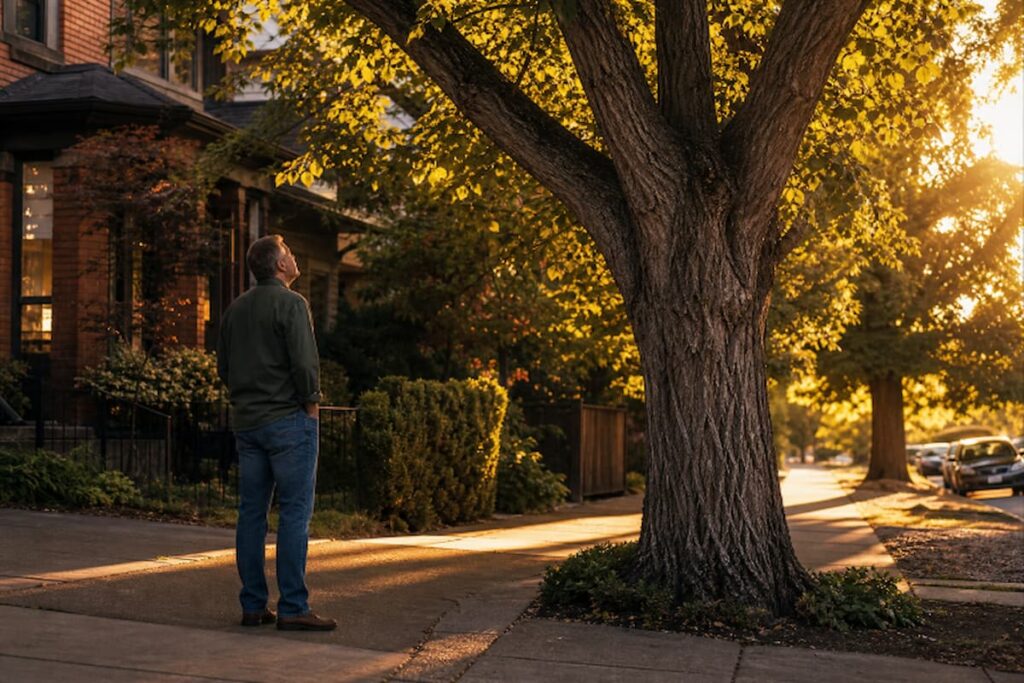
A brief inspection every few weeks, especially during hot or stormy periods, can help property owners notice changes. Start from a safe distance, look at the full canopy, then inspect the trunk base and visible roots. Never climb a tree or stand beneath a branch that appears damaged.
Signs To Look For
- Dead, broken, hanging, or unusually bare branches.
- Cracks near large branch unions or along the trunk.
- Mushrooms, fungal growth, or cavities near the root flare.
- Loose bark, fresh wounds, or peeling areas that keep expanding.
- New leaning, lifted soil, or exposed roots around the base.
- Branches rubbing against roofs, vehicles, structures, or utility lines.
A full canopy does not guarantee that every limb is secure. One large, poorly attached branch above a driveway or walkway may need prompt assessment even if the rest of the tree appears healthy.
What Smart Pruning Should Accomplish
Pruning should always have a clear purpose. Good cuts can remove dead or damaged wood, improve clearance, reduce rubbing branches, and guide young trees toward stronger structure. The goal is not to force a perfectly uniform shape. It is to preserve the tree’s natural form while addressing specific safety and health concerns.
Useful Pruning Goals
- Remove dead, broken, diseased, or storm-damaged branches.
- Create reasonable clearance over paths, roofs, and driveways.
- Address crossing branches before they create wounds.
- Develop one well-spaced central structure in young trees when appropriate.
- Reduce excessive end weight on selected limbs when a qualified professional recommends it.
Proper pruning also means making cuts at the correct location and avoiding unnecessary removal. Guidance from University of Minnesota Extension on pruning trees and shrubs notes that pruning large trees is best left to qualified professionals, particularly when specialized equipment or climbing is required.
Why Over-Pruning Creates New Problems
Leaves produce the energy a tree needs to grow, defend itself, and recover from stress. Removing too much live canopy can expose branches and bark to harsh sunlight, reduce energy reserves, and stimulate fast-growing shoots that may be weakly attached. Topping, which removes large upper limbs or cuts branches back to stubs, is especially damaging because it disrupts natural structure and creates difficult wounds.
Pruning Mistakes To Avoid
- Topping a mature tree to reduce its height quickly.
- Removing large healthy limbs without a clear objective.
- Stripping too much interior foliage from the canopy.
- Leaving branch stubs instead of making proper cuts.
- Ignoring the tree’s future growth pattern and natural shape.
Restraint is often a sign of quality tree care. After appropriate pruning, a tree should still look balanced and natural, not like a collection of shortened branches.
Watering and Mulching Practices That Help
Short, frequent sprinkler cycles often moisten only the soil surface. Trees benefit more from slow watering that reaches deeper into the root zone, followed by enough time for the soil to drain. Check moisture several inches below the surface before watering, because a dry-looking top layer does not always mean the soil below is dry.
Basic Watering Steps
- Water slowly around the root zone, not directly against the trunk.
- Pause if water begins to run off, then allow it to soak in.
- Adjust watering for heat, wind, rainfall, soil type, and tree age.
- Watch for drought symptoms, but avoid keeping soil constantly saturated.
Organic mulch helps conserve moisture, moderate soil temperature, and reduce weed competition. Spread it broadly over the root zone, but keep it several inches away from the trunk. Mulch piled against bark can trap moisture and encourage decay.
A Seasonal Tree Care Checklist
Late Winter and Early Spring
- Look for broken limbs, cracks, and storm damage.
- Schedule structural pruning when suitable for the species.
- Inspect branch unions, trunks, and exposed roots.
Spring and Summer
- Monitor soil moisture during dry, windy, and hot periods.
- Watch for unusual leaf loss, pests, thinning foliage, or dieback.
- Check branches near play areas, roofs, driveways, and sidewalks.
Fall and Early Winter
- Clear debris from drainage areas and tree wells.
- Inspect trees before snow, ice, and high winds arrive.
- Review irrigation needs before seasonal freezes begin.
What To Do After Wind, Snow, or Heavy Storms
- Keep people and pets away from damaged branches.
- Treat every downed wire as live and contact the utility provider.
- Photograph damage from a safe location for documentation.
- Do not climb the tree or try to pull down hanging limbs.
- Arrange a professional inspection if major limbs, the trunk, or roots are affected.
A fallen limb does not automatically mean the entire tree must be removed. Depending on the damage and the tree’s condition, pruning, monitoring, support, or removal may be the safest option.
Choosing Trees for the Site
Strong tree care begins before planting. Select a species that matches the available sunlight, soil, water supply, and mature space. Consider root room, overhead utilities, nearby buildings, and the tree’s expected height and canopy spread. A smaller tree in a suitable location often performs better than a larger species planted where it will eventually outgrow the space.
When To Call a Qualified Tree Care Professional
Small, reachable cuts on a young tree may be manageable with clean tools and sound technique. Professional help is the safer choice for mature trees, branches near power lines, visible trunk cracks, suspected decay, root movement, storm damage, or any work requiring climbing, ropes, or power equipment.
Final Thoughts
Healthy urban trees are supported by small, timely actions. Inspect them regularly, water deeply during dry periods, mulch correctly, prune with purpose, and choose trees that fit their site. This steady approach helps trees handle everyday city stress while reducing the likelihood of preventable damage and costly emergencies.